Screenings documentary Máximapark

Details
Documentary: ‘Máximapark – van glastuinbouw naar levend landschap’ (from greenhouse horticulture to living landscape)
Director: Hans den Hartog
Camera: Jeffrey van Houten and Hans den Hartog
Editing and colour correction: Niels Dekker
Audio editing: Mark Meewis
Producer: DUCREATIONS Film Productions
Length: 83 minutes
Language: Dutch
Screenings 2026 in Pathé Leidsche Rijn:
Tue 6 Jan 7.30 p.m.
Sun 11 Jan 1 p.m.
Thu 15 Jan 7 p.m.
Sun 18 Jan 2 p.m.
Sun 25 Jan 3 p.m.
Sun 1 Feb 3.15 p.m.
Sun 8 Feb 1.45 p.m.
Sun. 1 March 2 p.m. Satellite screenings in Utrecht – Amersfoort – Ede
Check for more screeningsMáximapark - van glastuinbouw naar levend landschap
In the heart of the Randstad lies a unique part of the Netherlands: the Máximapark. Just 25 years ago, it was still populated by horticulturalists, but now it is a lively, green icon of modern landscape architecture and community spirit.
From its roots in greenhouse horticulture and surprising archaeological finds from Roman times to its carefully designed landscape: the Leidsche Rijn master plan by urban planner Riek Bakker and the Máximapark designed by landscape architect Adriaan Geuze, where rare flora and fauna have found their place, for example in the Butterfly Garden designed by Piet Oudolf. The park is a living mosaic of nature, history and culture. Volunteers from diverse backgrounds work side by side here to maintain and nurture this young but meaningful place. Park visitors find peace, tranquillity, experience and movement here.
Hans den Hartog’s film Máximapark is an ode to the power of cooperation, the importance of heritage, and the beauty of a landscape in which people and nature reinforce each other.
Trailer
Screenings
The film is currently enjoying a successful run at the Pathé Leidsche Rijn cinema, with over 3,000 visitors to date.
On Sunday 1 March, there will be satellite screenings at Pathé Utrecht LR, Amersfoort and Ede.
In addition to further roll-out to various arthouse cinemas, an educational programme for secondary schools is also being set up, consisting of a film screening linked to a guest speaker and an excursion to the park. Landscape artist and WUR lecturer Paul de Kort (featured in the film with the construction of a new work of art) will screen the film to students at WUR.
Sponsors
This film was made possible by: Province of Utrecht Municipality of Utrecht Utrecht Entrepreneurs Fund Initiatives Fund Municipality of Utrecht Creative Industries Fund The Culture Fund BPD Culture Fund STITU former gardeners Vleuten-De Meern K.F. Hein Fund Brotherhood Vleuten Carel Nengerman Fund.
Director
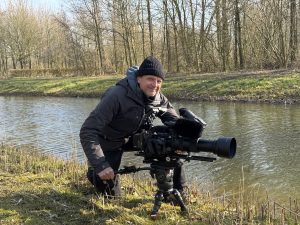
Following his successful documentary De Vogelwachter; tijd bestaat niet, enkel tij (The Birdwatcher: Time Does Not Exist, Only Tides), Vleuten-based filmmaker Hans den Hartog collaborated on Silence of the Tides (a film by Pieter-Rim de Kroon) after making a film about active older people (Old Passioned). Since 2016, he has been working on a film about the Fish Migration River, an ecoduct for fish through the Afsluitdijk (expected completion mid-2027). Hans has spent more than three years working on this feature-length documentary about the Máximapark.
Crew
Of course, a film like this cannot be produced alone. A small team is responsible for this production. In addition to director Hans den Hartog, nature filmmaker Jeffrey van Houten and editor Niels Dekker also contributed. Mark Meewis was responsible for the audio editing.
Jeffrey has worked on various cinema films, including Wild, Onze Natuur (Belgium), Silence of the Tides, Vogels kun je niet melken (You Can’t Milk Birds) and De Wilde Noordzee (The Wild North Sea).
Niels has worked as an editor on Binnenste Buiten (Inside Out), De Tiende van Tijl (Tijl’s Tenth), Wildernis onder Water (Wilderness Under Water) and De Stad was van Ons (The City Was Ours), among others.